


You’ve just been in a car accident. You’re shaken and aching, and your first thought is to call an ambulance, not your insurance company. You’re not thinking about money — not yet.
In 2024, 2.42 million people were injured in U.S. crashes, according to National Highway Traffic Safety Administration (NHTSA). That's more than 6,600 people a day, or one every 13 seconds.
If you’re one of them, your first priority is probably just making sure everyone is OK. But once you’ve been patched up, you might wonder: Who’s going to pay for all this?
CarInsurance.com breaks down the costs of a car accident, including medical bills, out-of-pocket expenses and potential increases in insurance premiums, and offers tips on understanding what your coverage may pay.
How much does a car accident really cost?
Motor-vehicle crashes cost the country an estimated $559.3 billion in 2024, including lost wages, medical care, administrative costs, vehicle damage and employer costs, according to the National Safety Council.
The real cost of a car accident is made up of three different parts:
- Medical costs for treating injuries
- Out-of-pocket costs (including a deductible)
- The increase in your car insurance premium after an accident
You might be focused on the price of repairing your car, but bodily injury claims can account for a larger share of insurance payouts than vehicle claims. In 2025, bodily injury payouts made up 52.3% of combined injury and vehicle-damage payouts, up from 44.4% in 2022, according to CCC Intelligent Solutions analysis.
Injury claims are relatively rare, but when they do happen, they can be costly. The average bodily injury claim in 2024 was $28,278, according to the Insurance Information Institute. That year, there's an average of 0.80 bodily injury claims for every 100 insured cars.
The first bills: ambulance, ER and treatment
After an accident, one of the first bills you'll probably have to pay is your share of the ambulance bill. The average cost of an ambulance trip for people with employer-sponsored health coverage was $1,093 in 2021, while the average out-of-pocket cost was $229, according to the Health Care Cost Institute.
Medical costs after an accident vary depending on the severity of the injuries. That’s why it’s difficult to pinpoint an “average medical bill,” as costs depend on many factors.
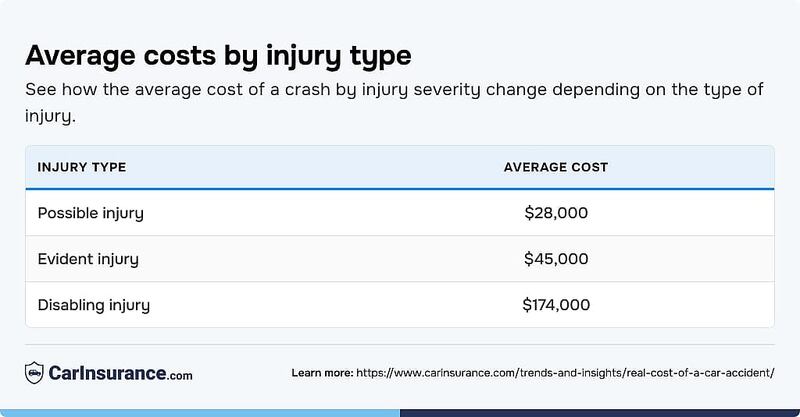
According to the National Safety Council, the average cost per person injured in a motor-vehicle crash in 2024 was $28,000. If the injury is clearly evident, that average jumps to $45,000. After an accident involving a disabling injury, the average cost is about $174,000. If the crash results in a death, the estimated cost is $2.05 million, according to the National Safety Council.
Average cost of a crash injury, by severity
The more serious the injuries involved, the higher the average cost. The difference between a possible injury and a disabling injury is $146,000.
The table below shows the average cost of a crash by injury severity, including medical bills, lost wages and other costs.
CarInsurance.com
Injury definitions:
- Possible injury: An injury that is claimed or reported but not visible at the scene, such as a complaint of pain or nausea, limping or a brief loss of consciousness.
- Evident injury: An injury that is visible at the scene, such as bruises, scrapes, a lump on the head or minor cuts.
- Disabling injury: A serious injury that keeps the person from walking, driving or carrying on normal activities, such as broken bones, crush injuries or paralysis.
Who pays first: Your health insurance or your car insurance plan?
When bills start coming in after an accident, which insurance pays first depends on the state you live in and the coverage you carry. In at-fault states, the driver who caused the accident is responsible for paying the medical expenses through their liability insurance coverage. In no-fault states, each driver's medical expenses are covered by their own insurance.
There are only 12 no-fault states: Florida, Hawai‘i, Kansas, Kentucky, Massachusetts, Michigan, Minnesota, New Jersey, New York, North Dakota, Pennsylvania and Utah.
Which policy pays first depends on where you live and what you carry.
In many no-fault states, personal injury protection (PIP) pays for medical care first. In at-fault states, your health insurance may cover medical bills while the other driver's liability claim is pending, and the health insurer may seek reimbursement from any settlement when allowed. In Michigan, drivers who choose coordinated benefits, your health plan pays first.
In no-fault states, each driver's PIP coverage typically pays toward their own medical bills. The average PIP claim is $8,966, with 12.9 claims per 1,000 insured vehicles each year, according to Highway Loss Data Institute data on 2022-24 model-year vehicles.
Medical payments coverage (MedPay) is an optional car insurance coverage in many states that can help pay medical bills for you and your passengers, even if you were at fault in the accident. The average MedPay claim is $4,674, with an average of 10.3 claims per 1,000 insured vehicles each year.
Which coverage pays which medical bills?
The bills you receive after an accident may be paid by different insurance coverages, as shown in the table below. In general, fault determines who may be responsible under bodily injury liability, but not necessarily whether PIP, MedPay or your health insurance covers eligible expenses.

CarInsurance.com
What comes out of your own pocket
Just because you're covered doesn't mean your care is free. Even with insurance, you may still owe money, starting with your deductible. The deductible is your share of a bill before insurance kicks in. According to KFF's 2025 Employer Health Benefits Survey, 88% of covered workers with single coverage have a general annual deductible. The average deductible for covered workers with a single-coverage policy was $1,886, according to the KFF survey. KFF is an independent health policy research organization.
If you don't have the cash to cover it, that could be a bigger problem. The Federal Reserve's 2025 report on the economic well-being of U.S. households found that only 63% of adults could cover a $400 emergency with cash or its equivalent, such as paying off a credit card balance right away. The remainder would need to use other methods, such as borrowing money or selling something. More than a fifth (21%) of adults had an unexpected major medical bill in the past year. And 18% carry some form of medical debt.
MedPay coverage can help bridge the gap by covering eligible expenses, including deductibles and copays, up to your policy limit.
What if the other driver has no insurance?
Uninsured motorist insurance can help cover your costs if the other driver doesn’t have insurance. This coverage is required in some states and optional in others. Depending on your policy and state, it may help to pay for:
- Your medical bills and medical bills for your passengers
- Damage to your vehicle in states that offer uninsured motorist property damage coverage
Uninsured motorist coverage is often paired with underinsured motorist coverage, which helps cover your costs if the other driver has insurance but it’s not enough.
More than one in seven drivers were uninsured in 2023, according to the Insurance Research Council, with the highest rate in Mississippi (28.2%) and the lowest in Maine (5.7%).
The table below shows the states with the highest and lowest rates of uninsured drivers.

CarInsurance.com
What if you caused the crash and the bill exceeds your limit?
A car insurance limit is the maximum amount the insurer will pay out for a covered claim. Higher coverage limits increase the amount your insurer can pay out after an accident. Limits are often written as a series of numbers, such as 25/50/25 or 50/100/50, that designate bodily injury limits per person, bodily injury limits per accident and property damage per accident.
If you have car insurance with 50/100/50 limits, your insurer will pay up to $50,000 per person for bodily injury liability claims, up to $100,000 per accident for all bodily injury claims and up to $50,000 per accident for property damage claims.
Recall the average bodily injury claim mentioned above: $28,278. In a state like Pennsylvania, where the minimum liability limits are 15/30/5, a single injury claim could exceed the $15,000 per-person bodily injury limit, leaving you responsible for the rest.
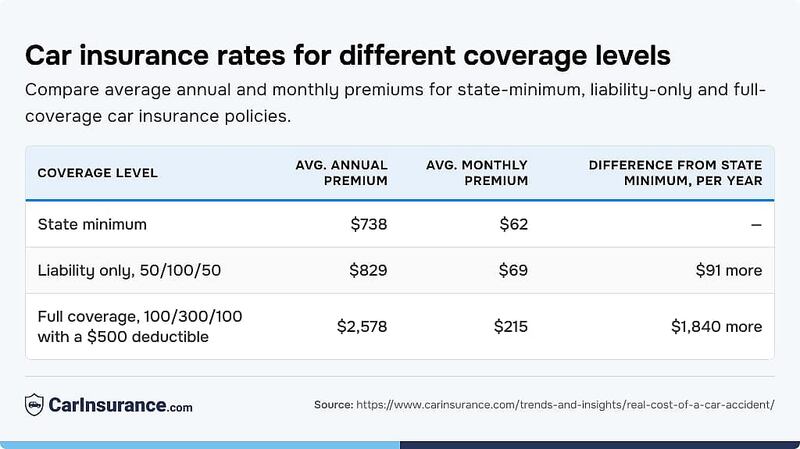
Raising your coverage limits provides greater financial protection if you need to file a claim, and it may not cost much more. The national average cost of state-minimum liability insurance is $738 per year, or $62 per month. If you raise those limits to 50/100/50, the average annual cost rises by $91, to $829.
Full coverage can bring those limits to 100/300/100 and also adds collision and comprehensive coverage, which pays if your car is damaged by a covered event. Full coverage costs an average of $2,578 per year, or $215 per month (with $500 deductibles), according to CarInsurance.com's 2026 State of Auto Insurance Report.
How much does more liability coverage cost?
It costs an average of $7 per month to switch from state-minimum coverage to 50/100/50 liability-only coverage, and $153 per month to switch to full coverage with 100/300/100 limits.
The table below breaks down the average premium increase across these coverage levels, from the state minimum to 50/100/50 liability-only to full coverage with 100/300/100 limits.
CarInsurance.com
Those figures are national averages, but car insurance costs can vary significantly depending on where you live.
The costs that show up later: higher premiums
Once the bills are all paid, there’s still one more cost to consider: an increase in your car insurance premiums. This surcharge may apply when you are the driver at fault in an accident, but you typically won’t see it reflected in your car insurance bill until renewal.
One at-fault accident involving less than $2,000 in property damage could raise your rates by an average of 55%. With two at-fault accidents under your belt, many insurers may consider you a high-risk driver. You can expect your rates to more than double, rising an average of 136%.
How much do rates rise after an at-fault accident?
An at-fault accident on your driving record changes the risk analysis used to insure you, which is why your rates may go up at renewal. One at-fault accident can raise your rate 55% to 64%. Two at-fault accidents can raise your rate by an average of 136%.
The table below shows how much rates rise after at-fault accidents with different characteristics, such as property damage or injuries.

CarInsurance.com
How to check how much your policy would pay
Find out how much your car insurance policy would pay after an accident by checking three places in your declarations document:
- Bodily injury liability (per person and per accident)
- Property damage liability (per accident)
- Uninsured/underinsured motorist coverage (if you have it)
Compare your figures with the average bodily injury claim from the first section of this article. If you were in an accident, would your bodily injury coverage be enough for the average injury claim?
If not, you may need more coverage to help yourself financially. Ask your insurer two questions:
- How much would it cost to raise each limit?
- Is MedPay an available coverage?
You may find that the increase in coverage doesn’t cost as much as you think.
Frequently Asked Questions
Do I have to pay my health insurance back after a settlement?
Often, yes. You may need to reimburse your health insurance plan if it paid bills that someone else's insurer later covered. Whether you have to repay the plan depends on its terms and applicable law.
Check your health plan documents for a “subrogation” clause. This is the legal language that allows them to recover costs they paid when another party is responsible for the expenses.
Will using MedPay raise my rate?
Medical payments coverage, or MedPay, helps cover your and your passengers’ medical bills and expenses regardless of who was at fault in the accident. A MedPay claim on its own may not raise your rate, especially if you weren't at fault. But if you caused the crash, the at-fault accident can still raise your premium.
Is MedPay worth it if I have health insurance?
Health insurance covers your medical costs, such as doctor visits, hospital care and medical treatments, subject to your plan’s deductible and copays. MedPay pays toward medical costs for you and your passengers, up to your policy limit. It could also cover your health insurance deductible, copay, and emergency medical expenses.
Does car insurance cover my passengers' medical bills?
MedPay and personal injury protection (PIP) generally cover passengers in your car, up to your policy limit. Check the details of your policy to see exactly what’s covered.
Do I need a lawyer after a car accident?
Whether you hire a lawyer after an accident depends on whether you have a dispute that requires action. You may be able to handle your claim through your insurer. Claims involving a lawyer took a median of nearly 440 days to close, more than double those without one, according to an Insurance Research Council auto injury claims study (for claims closed from 2017–22).
Conclusion
There are three kinds of costs you’ll pay after a car accident: medical costs, out-of-pocket costs and potentially higher insurance premiums when your policy renews.
To make sure you have enough car insurance to cover your expenses, check your declarations page and find the limits discussed in the last section: bodily injury liability per person and per accident and property damage liability.
If your coverage looks thin, ask your insurer what it would cost to raise those limits. Compare that to offers from other insurers to be sure you’re not overpaying.
Methodology
CarInsurance.com analyzed billions of data points to estimate how much car insurance rates increase after an at-fault accident.
To ensure consistency, calculations are based on male and female drivers age 40 who carry a full-coverage policy, with limits of 100/300/100 and $500 collision/comprehensive deductibles.
Injury costs, health deductibles, household finances, PIP and MedPay claims, and uninsured-driver rates are sourced from external sources.
This story was produced by CarInsurance.com and reviewed and distributed by Stacker.