
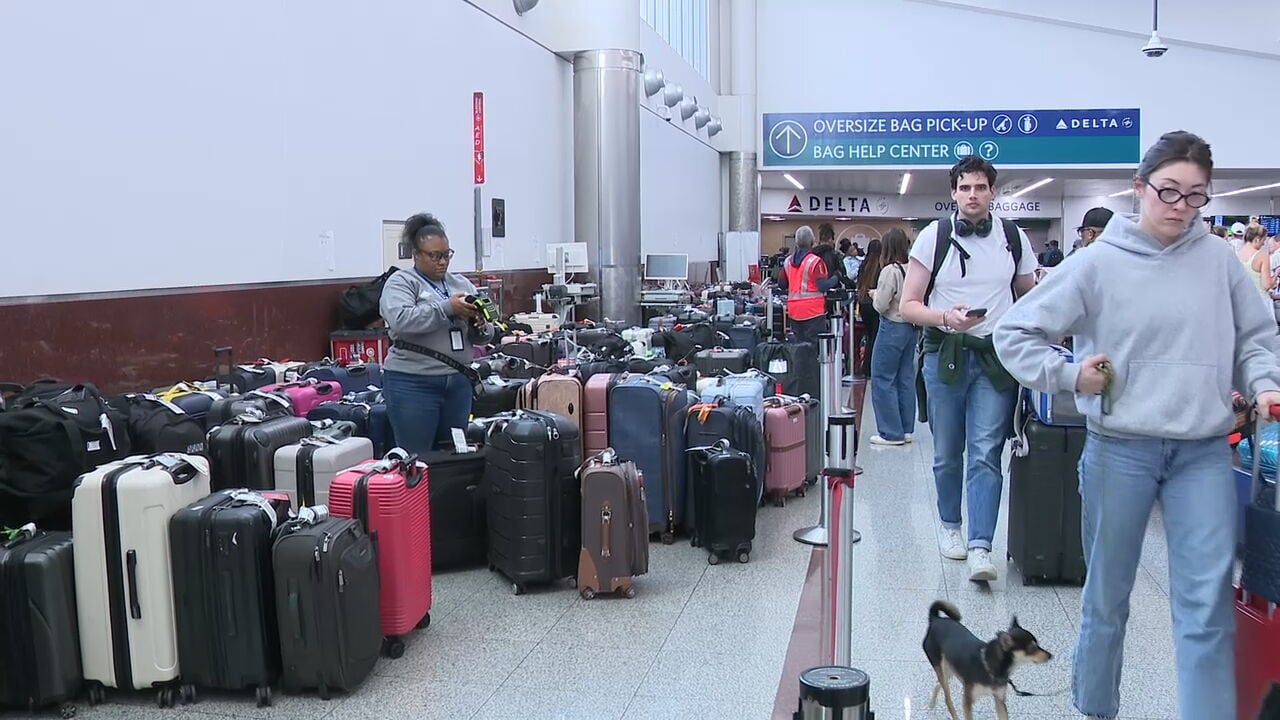
ATLANTA — Airlines across the country are still working to restore normal operations following a historic nationwide ground stop Friday that caused thousands of flight cancellations and delays, including at Hartsfield-Jackson Atlanta International Airport.
Atlanta-based Delta Air Lines is urging passengers who can postpone their travel plans until later this week to do so. The airline is also waiving flight change fees as it works to recover from the disruptions.
The Federal Aviation Administration (FAA) ordered a nationwide ground stop Friday that lasted more than four hours, making it the longest nationwide ground stop since Sept. 11, 2001.
More than 14,000 flights were canceled Friday and Saturday, with thousands more disruptions continuing into Sunday. More than 18,000 flights were canceled nationwide over the weekend.
Passengers caught in the disruptions described long waits and uncertainty about their travel plans.
“I just ended up waiting in line for like an hour, and still didn’t have any answers,” one passenger said.
Another traveler expressed frustration with the lack of assistance from airlines.
“They’re not accommodating any hotels and they said that they can’t do anything about it,” the passenger said.
ABC News travel contributor Katy Nastro described the disruption as unprecedented.
“This is the single worst, all time tech-induced outage ever,” Nastro said.
When it comes to what airlines must provide affected passengers, Nastro says travelers have limited options.
“The only real rights that you’re entitled to is that refund or that rebooked flight,” Nastro said.
The FAA attributed the ground stop to instability involving aircraft communications and radar feeds. Federal officials also pointed to problems involving copper wire replacement and a router connected to the air traffic control system. The FAA says safety was never compromised.
Transportation Secretary Sean Duffy says the outage highlights longstanding problems with the nation’s aviation infrastructure.
“For decades there’s been underinvestments or no investments in the FAA and the architecture of our infrastructure,” Duffy said.
Atlanta aviation attorney Alan Armstrong agrees that the country’s aging air traffic control equipment needs significant improvements.
“We’ve got controllers that are hardworking men and women, and they’re dedicated, they’re very capable, well trained, working under every circumstance with equipment that’s 50-60 years old and that’s just not right,” Armstrong said.
The United States is currently undergoing a $12 billion overhaul of its air traffic control systems. However, Duffy and other federal officials are calling for an additional $30 billion to $50 billion in funding to further modernize the equipment.
Armstrong believes the upgrades are urgently needed to prevent similar disruptions.
“The message for the nation is, we better fix this and I mean right now. This is dangerous. This is not good,” Armstrong said.
The FAA and Department of Transportation are scheduled to brief Congress Monday on the nationwide ground stop and its continuing impact on air travel.
By late Monday morning, more than 1,000 flights were delayed nationwide and approximately 300 had been canceled. Hartsfield-Jackson Atlanta International Airport reported just 10 cancellations as operations continued returning to normal.
Despite the improvements, Delta continues encouraging travelers with flexible schedules to rebook their flights for later in the week.
WSB Radio’s Ashley Simmons, Austin Eller, and Keith Cromwell contributed to this story.