


This fall, much of customer spending is going to companies that give AI agents a place to work, according to Brex, which has ranked the software vendors its customers are buying from most this fall.
The underlying AI model itself, the core foundational intelligence powering the software, is only part of what an AI agent costs. An agent is essentially a model that is allowed to act, and the acting (running code, running tests, reading a web page) happens on ordinary computers rented by the second from a different company for each job.
Reflecting the trends driving this season's rankings, companies that buy a coding agent rent one of those computers within six months at 16 times the rate of comparable companies. The share of graphics processing unit (GPU) buyers also renting one went from 12% to 29% in two years, and 31% of companies paying for a coding agent now also pay for a tool that reads the web for it. Those are the vendors climbing the list. Every figure here counts companies, not dollars.
Below is a look at the top 25 fastest-growing vendors for the fall capturing this momentum.
The top 25 trending software vendors in fall 2026

Source: Brex data
The ranking orders vendors by how fast Brex customers’ spending on them is growing, weighted toward recent months. Any vendor that is publicly traded, valued above $30 billion, or reporting more than $1 billion in annual recurring revenue graduates off the list, along with subsidiaries of companies that clear those bars. This is why Cursor, now part of SpaceX, and the closed-model labs, OpenAI and Anthropic, are not on it. The ranking is built from real Brex card and bill pay activity across thousands of customers.
Baseten (#1) runs models on GPUs. The vendors right behind it sell the places where agents act: Modal (#2) and Daytona (#4) sell sandboxes, isolated machines where an agent can run code without touching anything real; Blacksmith (#6) sells the machines that test that code; Render (#13) runs the finished apps.
Trend 1: The GPU makes the model while the CPU runs the agent.

Source: Brex Benchmark fall 2026
An AI agent works in a loop: It reads a task, tries something, checks the result, and decides what to do next. The decision happens in the AI model, which runs on a GPU. The action, like copying code and running tests, happens on ordinary computers built around CPUs. For each task the agent rents a temporary, isolated computer called a sandbox, and it can do this hundreds of times a day.
Buy the agent, rent the machine. In this study, companies follow the same order: They pay for the agent first, then start renting the computers. Within six months of their first payment to a coding agent (Cursor, Cognition, Amp, Replit, Lovable or Windsurf, between January 2025 and March 2026), 1 in 6 companies started paying for a sandbox, a testing service or hosting for the first time, and half did it within eight weeks.
That is well above the norm. Compared with companies of the same age and the same spending that never bought a coding agent, first-time coding-agent buyers were about six times as likely to add one of these services within six months (13.7% versus 2.3%) and about 16 times as likely to add a sandbox or testing service (3.3% versus 0.2%). These are counts of companies, not dollars. When a company pays for both, it bought the agent first four times in five.

Source: Brex data
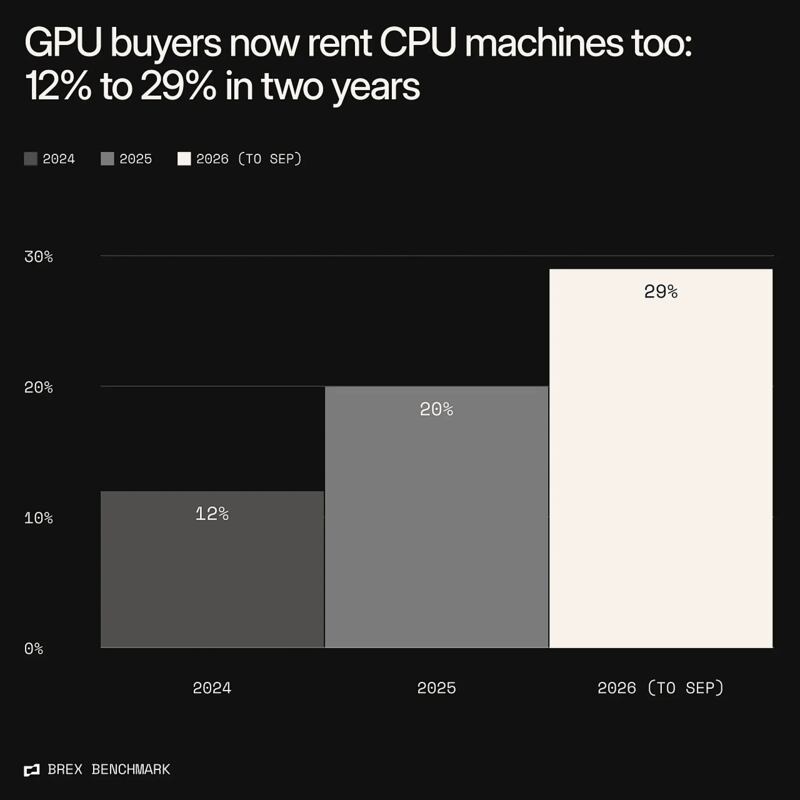
Companies that already pay for GPUs are adding the same rented computers. In 2024, 12% of them also paid for a sandbox or testing service, rising to 20% in 2025 and 29% so far in 2026. And nearly all of this year's first-time sandbox or testing buyers, 97%, were already paying OpenAI, Anthropic or a GPU vendor.
Source: Brex data
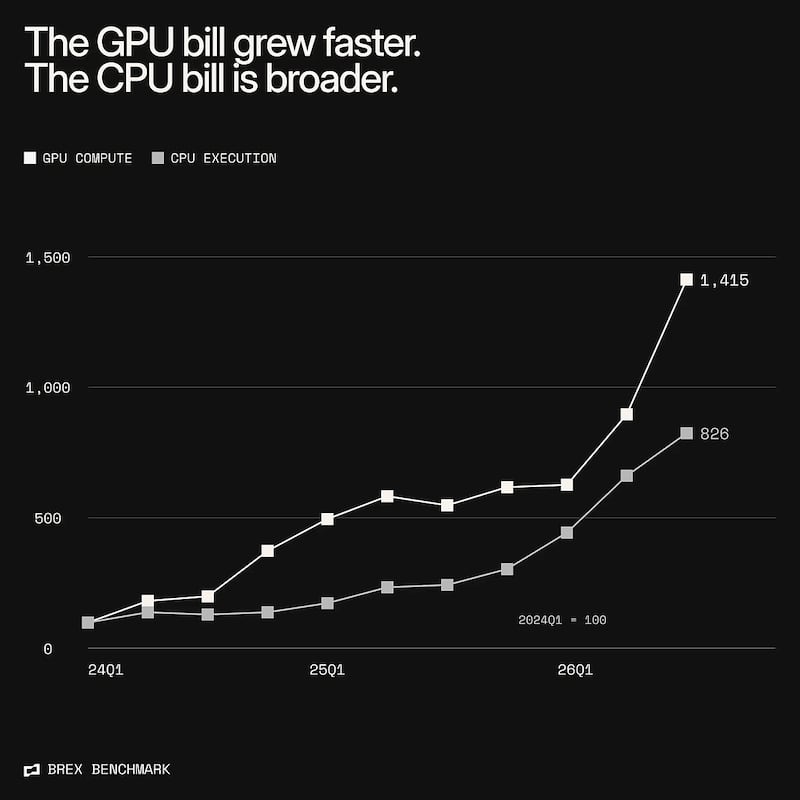
Since early 2024, spend on GPUs is up about 15 times, against 10 times for CPU execution, and the ranking holds with each vendor's largest customer set aside and with Vercel removed. The CPU bill is broader: More than three times as many companies pay for CPU execution as for GPU compute, and the typical monthly bill in both groups held flat or fell, so the growth is new companies arriving rather than bigger bills. Card and bill pay see what startups buy for themselves, not enterprise contracts, so this is a census of the startup layer, where new tools get chosen.
Source: Brex data
Trend 2: The web, resold to agents
An agent also needs to read documentation and other web pages, and websites are built for people, not software. An agent cannot click around a page, so it needs the information delivered as clean text with the source attached, often many times per task. A new group of vendors sells that, and Parallel (#20) is the newest.
Among companies that pay OpenAI or Anthropic, the share also paying for this kind of web access rose from 7% in 2023 to 19% in 2026, and 31% of companies paying for a coding agent now pay for a tool that reads the web for it. New buyers are choosing different tools, too. In 2023, 1 in 40 started with a tool built for agents, like Firecrawl, Exa or Browserbase, compared with 1 in 4 in 2024 and more than half in 2025 and 2026. These figures count companies, not dollars, and the older web-scraping tools still bring in more money.

Source: Brex data
The agent’s bill is now a multilayered cloud bill
The agent's loop runs straight through the list. It reads the documentation through Parallel, a model on Baseten decides the fix, a sandbox from Modal runs it, and tools like Blacksmith and Greptile test and review it. Every one of those steps is paid for by the second.
The trend to watch this winter is a change on the GPU side. Baseten's spend more than quadrupled quarter over quarter, which fits companies moving from paying for a model by how much they use it to running their own models on GPUs set aside for them. If the pattern of the last two years holds, more than a third of companies paying for GPUs will also be renting ordinary computers by spring.
All analysis conducted for this report that uses Brex internal customer data is anonymized and aggregated for privacy.
This story was produced by Brex and reviewed and distributed by Stacker.